Analysis of information sources in references of the Wikipedia article "Archaeology of Northern Europe" in English language version.
The northern Bronze Age may be said to begin shortly after 2000 BC with the introduction and use of simple bronze tools, especially axes. At the same time, huge longhouses for large (chiefly) households emerged. With the more systematic adoption of metalworking bronze technology after 1750 BC, a diversified use of new tools, weapons, and ornaments made of bronze appeared, together with a new warrior elite.
iron technology was practiced in the Nordic region from at least the ninth century BC (Hjärthner-Holdar 1993; Serning 1984)
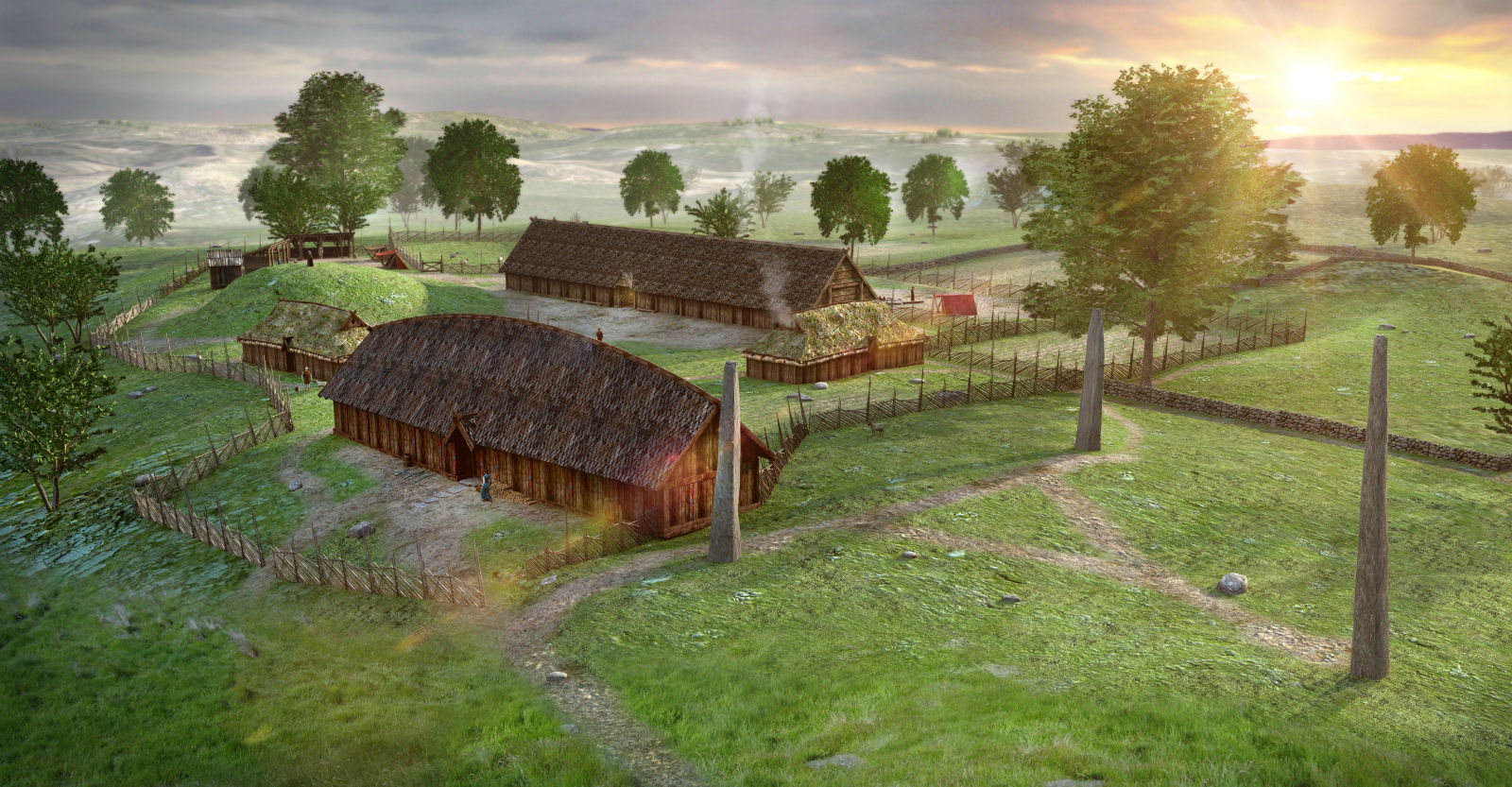
The first royal seat at Avaldsnes, about 300 AD. To the left; Hall facing the strait Karmsundet: Center of the picture; large long house. The triangular stone setting with bautas is the oldest one we know in Norway and the highest erected stones in Scandinavia. Illustration by Arkikon based on archaeological excavations.
The Early Bronze Age societies that evolved after 2000 BC thus inherited their basic social and cosmological order from the Beaker and Battle-Axe cultures of the third millennium BC.
a remarkable change occurred in the period c. 2200–2100 BC when Britain was the first region in Europe to completely switch all metalwork from (arsenical) copper to full tin-bronze (typically 10% tin). This full adoption or 'bronzization' subsequently occurred across Scandinavia and Central Europe by around 1800 BC and finally in southern Iberia, the Aegean and Egypt by around 1500/1300 BC
The northern Bronze Age may be said to begin shortly after 2000 BC with the introduction and use of simple bronze tools, especially axes. At the same time, huge longhouses for large (chiefly) households emerged. With the more systematic adoption of metalworking bronze technology after 1750 BC, a diversified use of new tools, weapons, and ornaments made of bronze appeared, together with a new warrior elite.
As early as c. 4400 BC, there are signs of a faint awareness of copper technologies in Scandinavia in the form of rare imports of copper axes into the region's Late Mesolithic communities. A thousand years later, local metallurgy was likely practiced in the Middle Neolithic Funnelbeaker culture, only to disappear again subsequently. During most of the third millennium, metallurgy seems absent from the region, even if experiments with casting copper axes and hammering sheet ornaments reappear in Bell Beaker environments in Jutland, 2400–2100 BC. ... At 2000 BC, however, a copper-based technology begins to achieve full economic and social integration in Scandinavia simultaneously with the spread of bronze, or copper with similar properties, across Europe
a remarkable change occurred in the period c. 2200–2100 BC when Britain was the first region in Europe to completely switch all metalwork from (arsenical) copper to full tin-bronze (typically 10% tin). This full adoption or 'bronzization' subsequently occurred across Scandinavia and Central Europe by around 1800 BC and finally in southern Iberia, the Aegean and Egypt by around 1500/1300 BC
experiments with casting copper axes and hammering sheet ornaments reappear in Bell Beaker environments in Jutland, 2400–2100 BC.
iron technology was practiced in the Nordic region from at least the ninth century BC (Hjärthner-Holdar 1993; Serning 1984)
As early as c. 4400 BC, there are signs of a faint awareness of copper technologies in Scandinavia in the form of rare imports of copper axes into the region's Late Mesolithic communities. A thousand years later, local metallurgy was likely practiced in the Middle Neolithic Funnelbeaker culture, only to disappear again subsequently. During most of the third millennium, metallurgy seems absent from the region, even if experiments with casting copper axes and hammering sheet ornaments reappear in Bell Beaker environments in Jutland, 2400–2100 BC. ... At 2000 BC, however, a copper-based technology begins to achieve full economic and social integration in Scandinavia simultaneously with the spread of bronze, or copper with similar properties, across Europe
experiments with casting copper axes and hammering sheet ornaments reappear in Bell Beaker environments in Jutland, 2400–2100 BC.
The Öland statuette of a woman has been interpreted as either a Roman deity, such as Venus and Juno, or possibly a Roman empress
As early as c. 4400 BC, there are signs of a faint awareness of copper technologies in Scandinavia in the form of rare imports of copper axes into the region's Late Mesolithic communities. A thousand years later, local metallurgy was likely practiced in the Middle Neolithic Funnelbeaker culture, only to disappear again subsequently. During most of the third millennium, metallurgy seems absent from the region, even if experiments with casting copper axes and hammering sheet ornaments reappear in Bell Beaker environments in Jutland, 2400–2100 BC. ... At 2000 BC, however, a copper-based technology begins to achieve full economic and social integration in Scandinavia simultaneously with the spread of bronze, or copper with similar properties, across Europe
experiments with casting copper axes and hammering sheet ornaments reappear in Bell Beaker environments in Jutland, 2400–2100 BC.
As early as c. 4400 BC, there are signs of a faint awareness of copper technologies in Scandinavia in the form of rare imports of copper axes into the region's Late Mesolithic communities. A thousand years later, local metallurgy was likely practiced in the Middle Neolithic Funnelbeaker culture, only to disappear again subsequently. During most of the third millennium, metallurgy seems absent from the region, even if experiments with casting copper axes and hammering sheet ornaments reappear in Bell Beaker environments in Jutland, 2400–2100 BC. ... At 2000 BC, however, a copper-based technology begins to achieve full economic and social integration in Scandinavia simultaneously with the spread of bronze, or copper with similar properties, across Europe
experiments with casting copper axes and hammering sheet ornaments reappear in Bell Beaker environments in Jutland, 2400–2100 BC.
iron technology was practiced in the Nordic region from at least the ninth century BC (Hjärthner-Holdar 1993; Serning 1984)
The Early Bronze Age societies that evolved after 2000 BC thus inherited their basic social and cosmological order from the Beaker and Battle-Axe cultures of the third millennium BC.
The northern Bronze Age may be said to begin shortly after 2000 BC with the introduction and use of simple bronze tools, especially axes. At the same time, huge longhouses for large (chiefly) households emerged. With the more systematic adoption of metalworking bronze technology after 1750 BC, a diversified use of new tools, weapons, and ornaments made of bronze appeared, together with a new warrior elite.
iron technology was practiced in the Nordic region from at least the ninth century BC (Hjärthner-Holdar 1993; Serning 1984)
{{cite web}}: CS1 maint: bot: original URL status unknown (link)