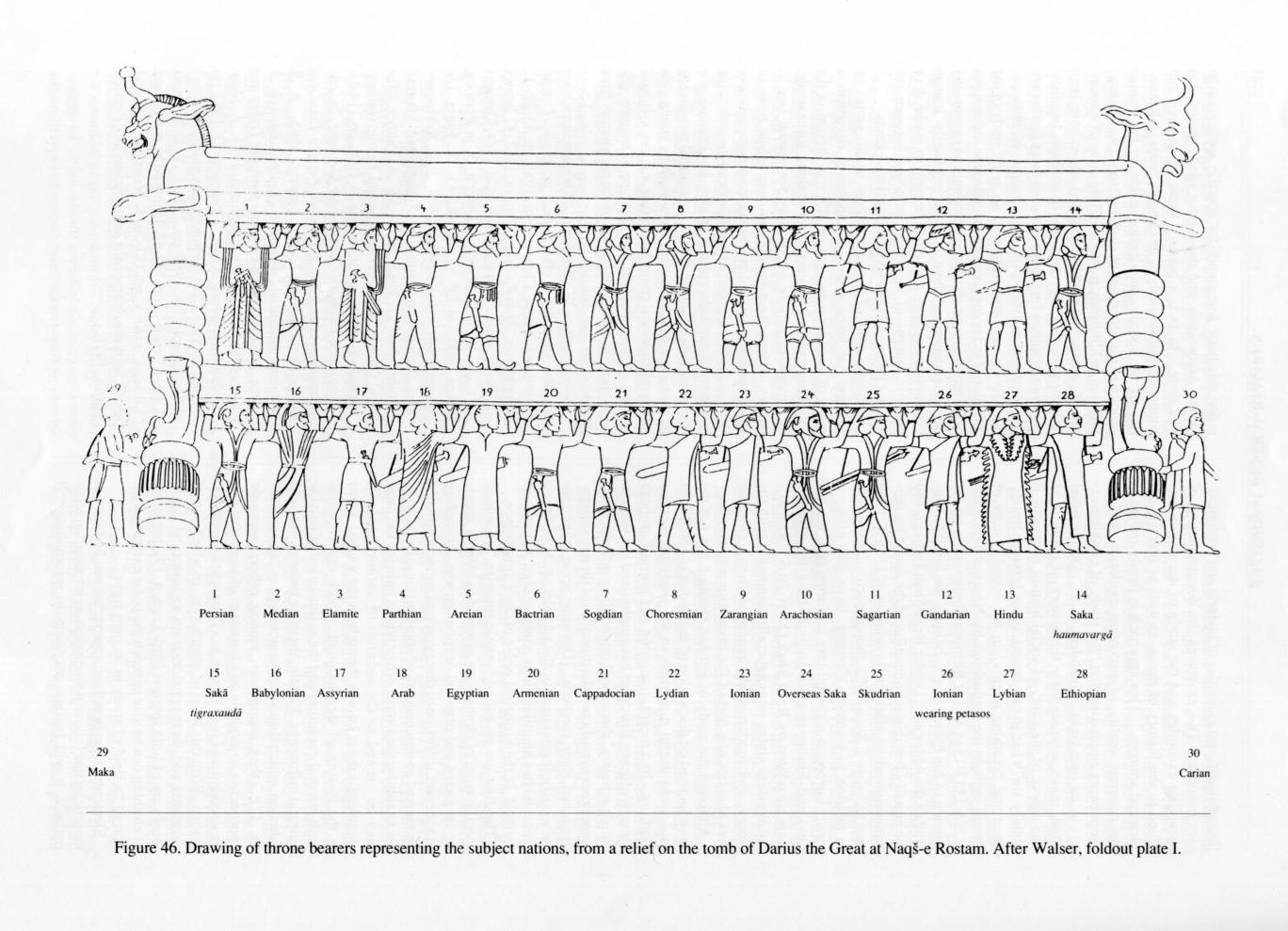
"Arachosia, Sattagydia, and India are represented and named among the subject nations sculptured on the base of the Egyptian statue of Darius I from Susa."Yar-Shater, Ehsan (1982). Encyclopaedia Iranica. Routledge & Kegan Paul. p. 10. ISBN9780933273955.
Horrocks, Geoffrey (2009), Greek: A History of the Language and its Speakers (Second ed.), John Wiley & Sons, pp. 27–28, ISBN978-1-4443-1892-0: "Note finally that the letter H/η was originally used to mark word-initial aspiration... Since such aspiration was lost very early in the eastern Ionic-speaking area, the letter was recycled, being used first to denote the new, very open, long e-vowel [æ:] ... and then to represent the inherited long e-vowel [ε:] too, once these two sounds had merged. The use of H to represent open long e-vowels spread quite early to the central Ionic-speaking area and also to the Doric-speaking islands of the southern Aegean, where it doubled up both as the marker of aspiration and as a symbol for open long e-vowels."
Panayotou, A. (2007), "Ionic and Attic", in A.-F. Christidis (ed.), A History of Ancient Greek: From the Beginnings to Late Antiquity, Cambridge University Press, p. 410, ISBN978-0-521-83307-3: "The early loss of aspiration is mainly a characteristic of Asia Minor (and also of the Aeolic and Doric of Asia Minor)...In Attica, however (and in some cases in Euboea, its colonies, and in the Ionic-speaking islands of the Aegean), the aspiration survived until later... During the second half of the fifth century BC, however, orthographic variation perhaps indicates that 'a change in the phonetic quality of [h] was taking place' too."
Arora, Udai Prakash (2005), "Ideas of India in Ancient Greek Literature", in Irfan Habib (ed.), India — Studies in the History of an Idea, Munshiram Manoharlal Publishers, p. 47, ISBN978-81-215-1152-0: "The term 'Indians' was used by Herodotus as a collective name for all the peoples living east of Persia. This was also a significant development over Hekataios, who had used this term in a strict sense for the groups dwelling in Sindh only."
"A Sindhu contingent formed a part of his army which invaded Greece and stormed the defile at Thermopylae in 480 BC, thus becoming the first ever force from India to fight on the continent of Europe. It, apparently, distinguished itself in battle because it was followed by another contingent which formed a part of the Persian army under Mardonius which lost the battle of Platea"Sandhu, Gurcharn Singh (2000). A military history of ancient India. Vision Books. p. 179. ISBN9788170943754.