Rumble (instrumental) (English Wikipedia)

Analysis of information sources in references of the Wikipedia article "Rumble (instrumental)" in English language version.

refsWebsite
Global rank English rank
3rd place
3rd place
159th place
112th place
1st place
1st place
70th place
63rd place
6th place
6th place
19th place
18th place
8,624th place
5,168th place
206th place
124th place
3,662nd place
2,258th place
7th place
7th place
47th place
38th place
low place
9,758th place
5th place
5th place
2,227th place
1,380th place
low place
9,060th place
34th place
27th place
9th place
13th place
32nd place
21st place
4,263rd place
2,705th place

45cat.com (Global: 2,227th place; English: 1,380th place)

archive.org (Global: 6th place; English: 6th place)

billboard.com (Global: 19th place; English: 18th place)

books.google.com (Global: 3rd place; English: 3rd place)

  • Richard Aquila (1989). That Old-time Rock & Roll: A Chronicle of an Era, 1954–1963. University of Illinois Press. p. 21. ISBN 978-0-252-06919-2.
  • Rodriguez, Robert A. (2005). The 1950s' Most Wanted: The Top 10 Book of Rock & Roll Rebels, Cold War Crises, and All-American Oddities. Potomac Books. p. 94. ISBN 978-1-57488-715-0. LCCN 2004013424.  'Rumble' has the distinction of being the only instrumental single banned from the radio airwaves. ... a song with such a provocative name and such menace to its power chords, could only spell trouble for impressionable listeners.
  • Tushnet, Mark V.; Chen, Alan K.; Blocher, Joseph (2017). "Instrumental Music and the First Amendment". Free Speech Beyond Words: The Surprising Reach of the First Amendment. NYU Press. p. 30. ISBN 978-1-4798-8028-7. LCCN 2016590840. OCLC 946161367. Nongovernmental institutions that control forums for musical expression have also played a censoring role. For example, in 1959, federally licensed American radio stations refused to broadcast the purely instrumental Link Wray song 'Rumble' on the basis of its title's association with street violence.

  • Maury Dean, Rock 'n' Roll Gold Rush: A Singles Un-Cyclopedia (Algora Publishing, 2003), p.438.

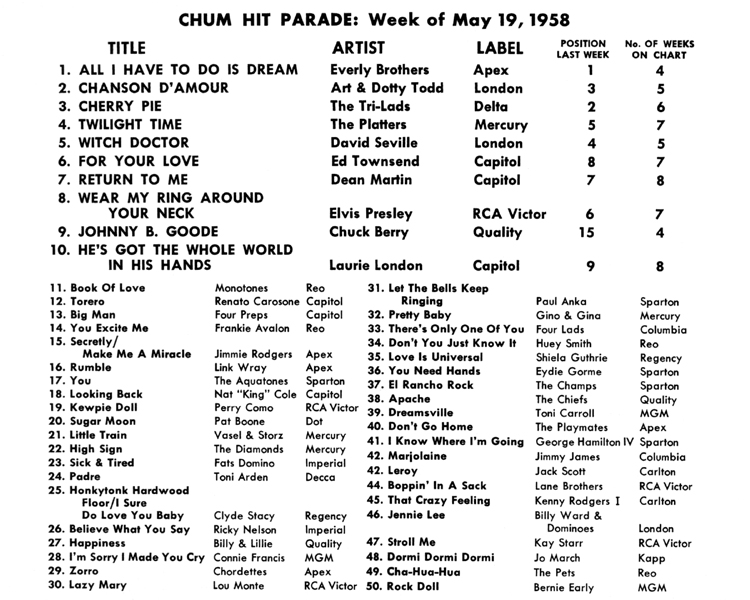
chumtribute.com (Global: low place; English: 9,060th place)

furious.com (Global: 8,624th place; English: 5,168th place)

fuse.tv (Global: 4,263rd place; English: 2,705th place)

  • "Fuse". Fuse.tv. Retrieved April 27, 2021.

ghostarchive.org (Global: 32nd place; English: 21st place)

loc.gov (Global: 70th place; English: 63rd place)

lccn.loc.gov

nysun.com (Global: 3,662nd place; English: 2,258th place)

nytimes.com (Global: 7th place; English: 7th place)

pitchfork.com (Global: 159th place; English: 112th place)

pophistorydig.com (Global: low place; English: 9,758th place)

proquest.com (Global: 206th place; English: 124th place)

  • Molenda, Michael (November 2007). "Blast from the Past: Link Wray's 'Rumble'". EQ. p. 51. ProQuest 199510916.

rollingstone.com (Global: 47th place; English: 38th place)

washingtonpost.com (Global: 34th place; English: 27th place)

web.archive.org (Global: 1st place; English: 1st place)

worldcat.org (Global: 5th place; English: 5th place)

search.worldcat.org

  • Tushnet, Mark V.; Chen, Alan K.; Blocher, Joseph (2017). "Instrumental Music and the First Amendment". Free Speech Beyond Words: The Surprising Reach of the First Amendment. NYU Press. p. 30. ISBN 978-1-4798-8028-7. LCCN 2016590840. OCLC 946161367. Nongovernmental institutions that control forums for musical expression have also played a censoring role. For example, in 1959, federally licensed American radio stations refused to broadcast the purely instrumental Link Wray song 'Rumble' on the basis of its title's association with street violence.

youtube.com (Global: 9th place; English: 13th place)