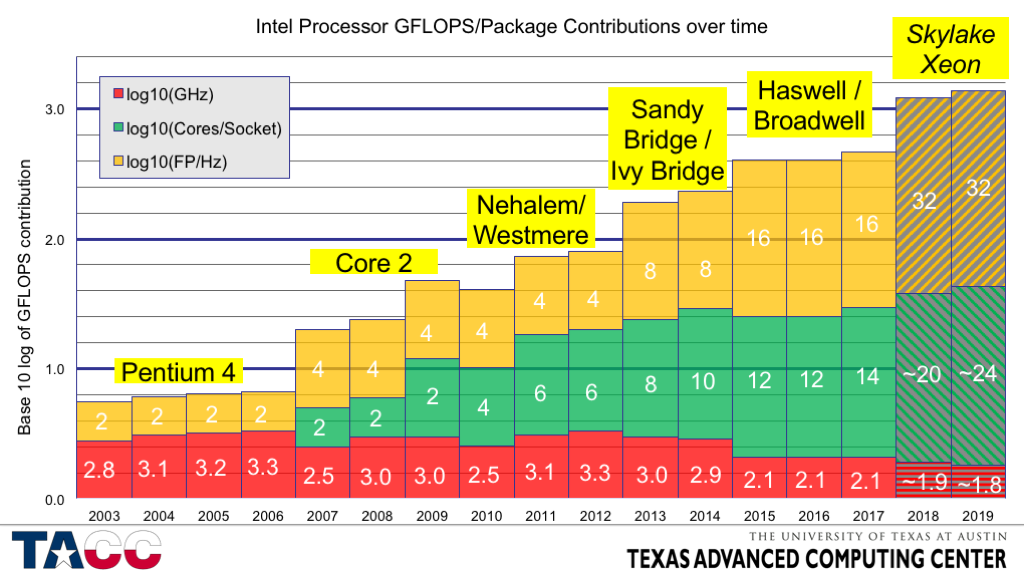
Jack Dongarra.Adaptive Linear Solvers and Eigensolvers(англ.).Argonne Training Program on Extreme-scale Computing.Argonne National Laboratory(13 августа 2014).Дата обращения: 13 апреля 2015.Архивировано из оригинала 24 апреля 2016 года.
Архивная копия от 3 декабря 2013 на Wayback Machine // CoinDesk [неавторитетный источник]: «Two, the estimates used to convert hashes to flops (resulting in about 12,700 flops per hash) date to 2011, before ASIC devices became the norm for bitcoin mining. ASICs don’t handle flops at all, so the current comparison is very rough.»
Архивная копия от 27 ноября 2013 на Wayback Machine // ExtremeTech: «As Bitcoin mining doesn’t rely on floating-point operations, these estimates are based on opportunity costs. Now that we have hardware with application-specific integrated circuits (ASIC) designed from the ground up to do nothing but mine Bitcoins, these estimates become even more fuzzy.»
Архивная копия от 30 августа 2017 на Wayback Machine // Gizmodo, 5/13/13: «Because Bitcoin miners actually do a simpler kind of math (integer operations), you have to do a little (messy) conversion to get to FLOPS. .. new ASIC miners—machines .. do nothing but mine Bitcoins—can’t even do other kinds of operations, they’re left out of the total entirely.»
Новый поворотАрхивная копия от 11 сентября 2013 на Wayback MachineБерд Киви, «Мир ПК», № 07, 2012: «Если нынешняя скорость прогресса суперкомпьютеров будет сохраняться, то следующий рубеж производительности в 1 экзафлопс, или квинтиллион (10^18) операций в секунду, ожидается достичь к 2019 г. … полагают, что компьютер производительностью один зеттафлопс (10^21 , или секстиллион операций) можно будет построить примерно к 2030 г. Более того, заранее припасены термины и для следующих вычислительных рубежей — йоттафлопс (10^24) и „ксерафлопс“ (10^27).»
Новый суперкомпьютер в МГУ вошел в Top500Архивная копия от 17 ноября 2016 на Wayback Machine // Мир ЦОД, Открытые системы, 19.11.2014: «В новом суперкомпьютере МГУ всего пять вычислительных стоек с 1280 узлами на базе 14-ядерных процессоров Intel Xeon E5-2697 v3 и ускорителей NVIDIA Tesla K40 с общей емкостью оперативной памяти более 80 Тбайт. … Каждая стойка суперкомпьютера потребляет около 130 кВт»
Архивная копия от 3 декабря 2013 на Wayback Machine // SlashGear, May 13, 2013: «Bitcoin mining technically doesn’t operate using FLOPS, but rather integer calculations, so the figures are converted to FLOPS for a conversion that most people can understand more. Since the conversion process is a bit weird, it’s led to some experts calling foul on the mining figures.»
Архивированная копия.Дата обращения: 17 августа 2009.Архивировано из оригинала 15 октября 2009 года.HPL is a software package that solves a dense linear system in double precision (64 bits)
Архивная копия от 3 декабря 2013 на Wayback Machine // VR-Zone: «A conversion rate of 1 hash = 12.7K FLOPS is used to determine the general speed of the network contribution. The estimate was created in 2011, before the creation of ASIC hardware solely designed for bitcoin mining. ASIC doesn’t use floating point operations at all,… Thus, the estimate doesn’t have any real-world meaning for such hardware.»
Новый поворотАрхивная копия от 11 сентября 2013 на Wayback MachineБерд Киви, «Мир ПК», № 07, 2012: «Если нынешняя скорость прогресса суперкомпьютеров будет сохраняться, то следующий рубеж производительности в 1 экзафлопс, или квинтиллион (10^18) операций в секунду, ожидается достичь к 2019 г. … полагают, что компьютер производительностью один зеттафлопс (10^21 , или секстиллион операций) можно будет построить примерно к 2030 г. Более того, заранее припасены термины и для следующих вычислительных рубежей — йоттафлопс (10^24) и „ксерафлопс“ (10^27).»
Архивированная копия.Дата обращения: 17 августа 2009.Архивировано из оригинала 5 июля 2009 года.these are single precision GPU peak numbers
Архивированная копия.Дата обращения: 17 августа 2009.Архивировано из оригинала 15 октября 2009 года.HPL is a software package that solves a dense linear system in double precision (64 bits)
Jack Dongarra.Adaptive Linear Solvers and Eigensolvers(англ.).Argonne Training Program on Extreme-scale Computing.Argonne National Laboratory(13 августа 2014).Дата обращения: 13 апреля 2015.Архивировано из оригинала 24 апреля 2016 года.
Новый суперкомпьютер в МГУ вошел в Top500Архивная копия от 17 ноября 2016 на Wayback Machine // Мир ЦОД, Открытые системы, 19.11.2014: «В новом суперкомпьютере МГУ всего пять вычислительных стоек с 1280 узлами на базе 14-ядерных процессоров Intel Xeon E5-2697 v3 и ускорителей NVIDIA Tesla K40 с общей емкостью оперативной памяти более 80 Тбайт. … Каждая стойка суперкомпьютера потребляет около 130 кВт»
Архивная копия от 30 августа 2017 на Wayback Machine // Gizmodo, 5/13/13: «Because Bitcoin miners actually do a simpler kind of math (integer operations), you have to do a little (messy) conversion to get to FLOPS. .. new ASIC miners—machines .. do nothing but mine Bitcoins—can’t even do other kinds of operations, they’re left out of the total entirely.»
Архивная копия от 3 декабря 2013 на Wayback Machine // SlashGear, May 13, 2013: «Bitcoin mining technically doesn’t operate using FLOPS, but rather integer calculations, so the figures are converted to FLOPS for a conversion that most people can understand more. Since the conversion process is a bit weird, it’s led to some experts calling foul on the mining figures.»
Архивная копия от 27 ноября 2013 на Wayback Machine // ExtremeTech: «As Bitcoin mining doesn’t rely on floating-point operations, these estimates are based on opportunity costs. Now that we have hardware with application-specific integrated circuits (ASIC) designed from the ground up to do nothing but mine Bitcoins, these estimates become even more fuzzy.»
Архивная копия от 3 декабря 2013 на Wayback Machine // CoinDesk [неавторитетный источник]: «Two, the estimates used to convert hashes to flops (resulting in about 12,700 flops per hash) date to 2011, before ASIC devices became the norm for bitcoin mining. ASICs don’t handle flops at all, so the current comparison is very rough.»
Архивная копия от 3 декабря 2013 на Wayback Machine // VR-Zone: «A conversion rate of 1 hash = 12.7K FLOPS is used to determine the general speed of the network contribution. The estimate was created in 2011, before the creation of ASIC hardware solely designed for bitcoin mining. ASIC doesn’t use floating point operations at all,… Thus, the estimate doesn’t have any real-world meaning for such hardware.»
Bitcoin Watch, архивная копия от 2011-04-08: «Network Hashrate TFLOP/s 8007»